Composition measurements
DV Lottery Photo Head Size and Eye Position Explained
A square image is not automatically framed correctly. Composition depends on the vertical size of the head and the location of the eye line in the finished file.
Reviewed against U.S. Department of State photo guidance
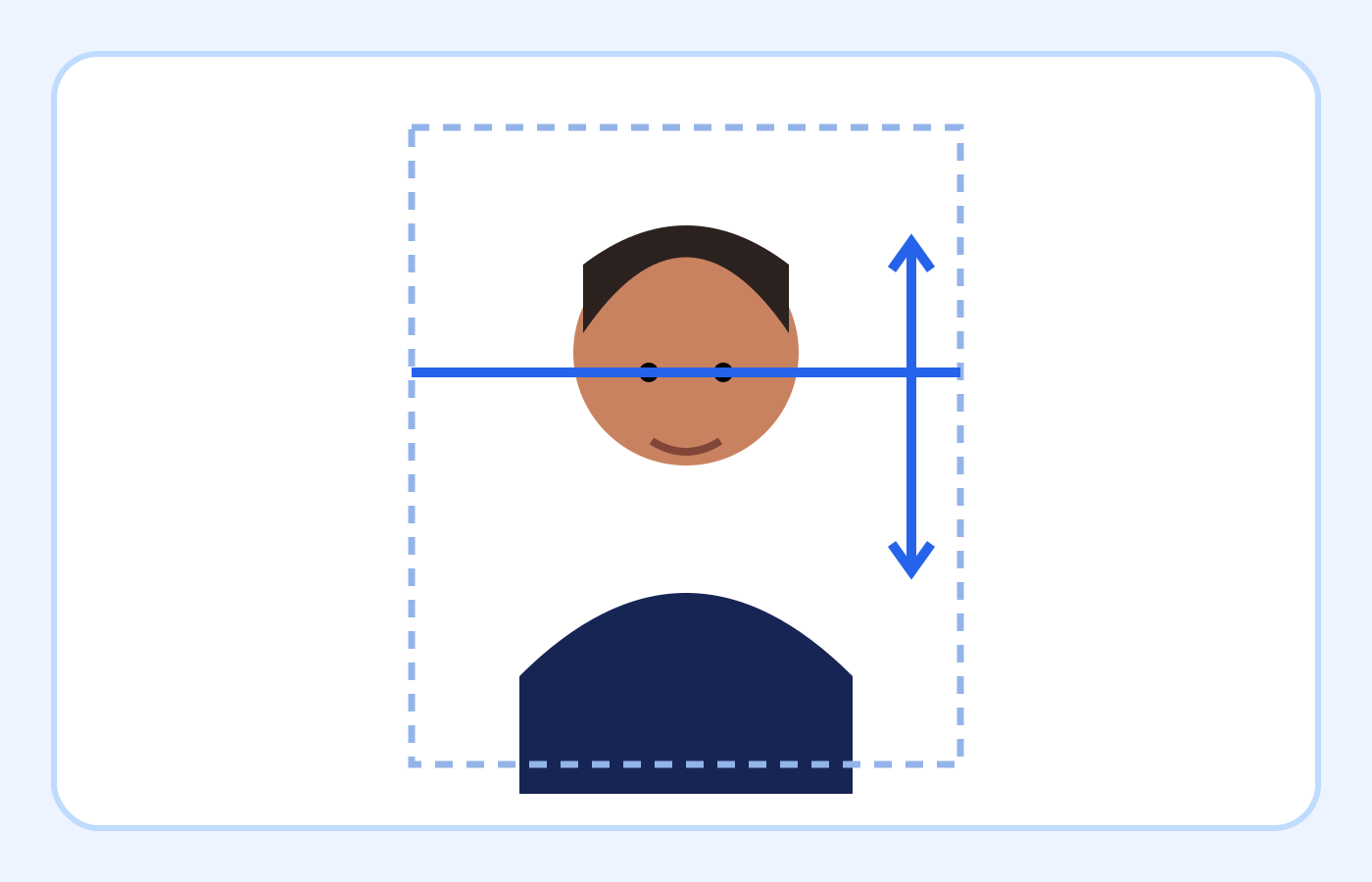
More visual examples
These are educational illustrations, not official government examples or photos to submit.
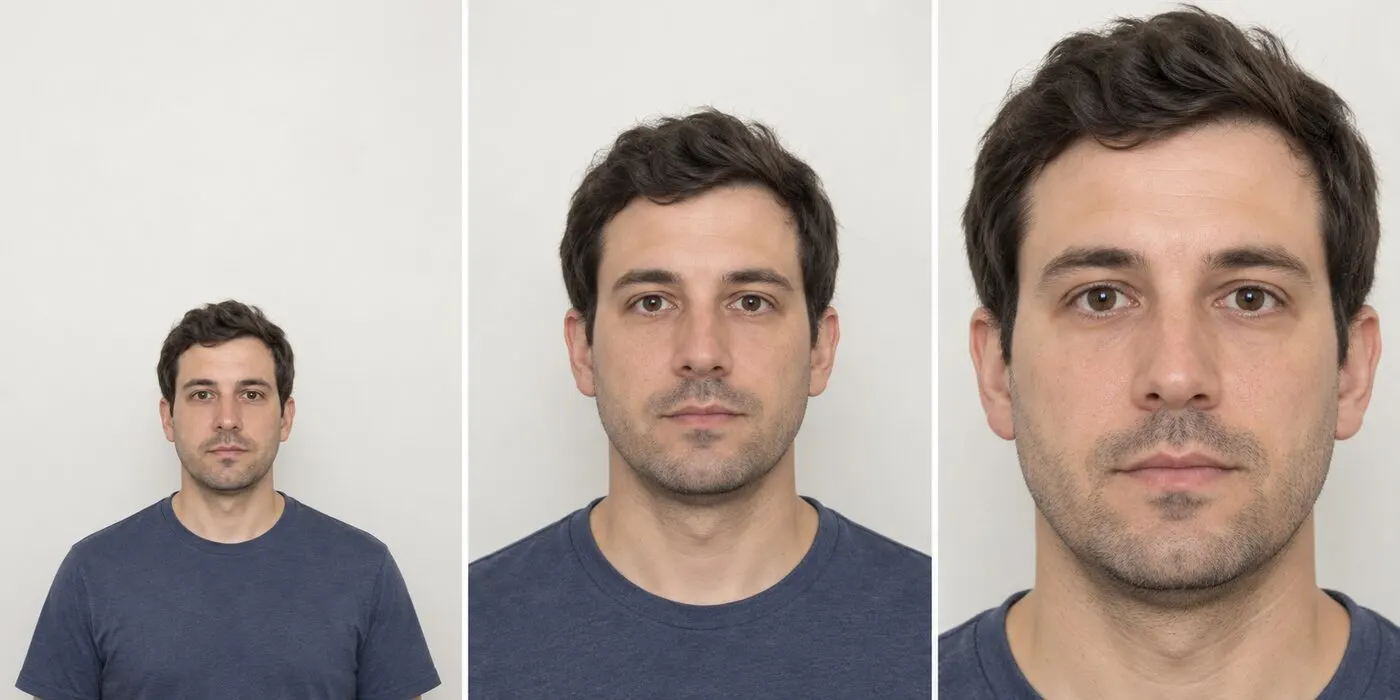
Composition measurements
| Measurement | Target | Review |
|---|---|---|
| Head height | 50%–69% | Chin to top of head |
| Eye height | 56%–69% from bottom | Bottom edge to eye line |
| Canvas | 600×600 pixels | Final JPEG |
| Shape | Square | Crop before resize |
| Pose | Directly forward | Check tilt and turn |
On smaller screens, swipe horizontally to see every column.
What the checker can—and cannot—verify
It can help with
- ✓ Checks that the final image is square and exactly 600×600 pixels.
- ✓ Estimates the chin-to-top-of-head proportion and eye-line position.
- ✓ Lets you adjust a square crop without stretching the face.
You must review yourself
- • Automatic landmarks are estimates and may need manual review around hair, head coverings or unusual poses.
- • The checker cannot judge photo age, natural appearance or every visible-content rule.
- • A passing estimate is not a guarantee of government acceptance.
How to use the checker
- 1Upload the highest-quality original rather than an already compressed screenshot.
- 2Place the square crop around the full head and upper shoulders without stretching the portrait.
- 3Use the composition overlay to check both head height and the eye line; changing the crop can affect both.
- 4Download the JPEG, reopen it and confirm 600×600 dimensions, natural proportions and clear facial detail.
Measure the head correctly
The official guidance places the distance from the bottom of the chin to the top of the head, including the hair, between 50% and 69% of the image height.
Make this measurement on the finished square crop. Adjust the crop around the original portrait; never stretch a rectangular face to force it into a square.
For a print-based source, check the scanning workflow before measuring the digital result.
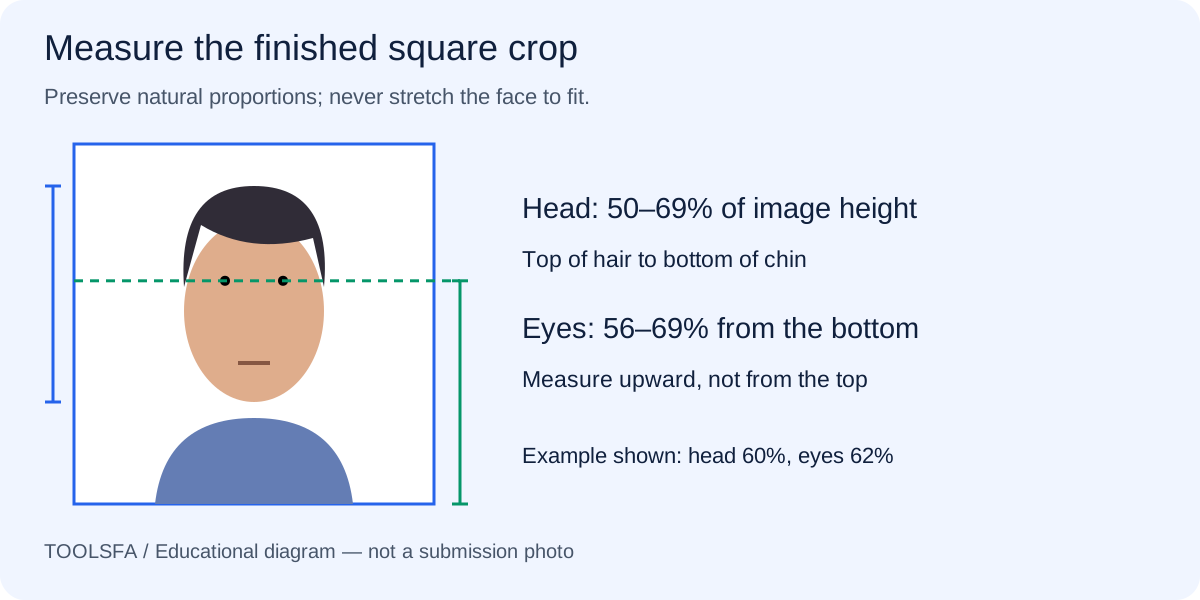
Check the eye line from the bottom
Eye height is measured upward from the bottom edge and should fall between 56% and 69% of the image height.
A face may look centered while the eyes remain too high or low. Recheck the eye line whenever you move or enlarge the crop.
Review the other checks in the complete photo requirements guide as well as the eye line.
Fix the crop, not the applicant
Begin with a sharp original that leaves space around the full head and upper shoulders. A wider original gives you room to move the square crop without cutting hair or chin.
If the head remains too small after a natural crop, crop closer. If it is too large or clipped, return to a wider original or retake the photo; invented canvas and distorted facial proportions are not safe fixes.
Once the crop is correct, use the compression guide to finish the JPEG.
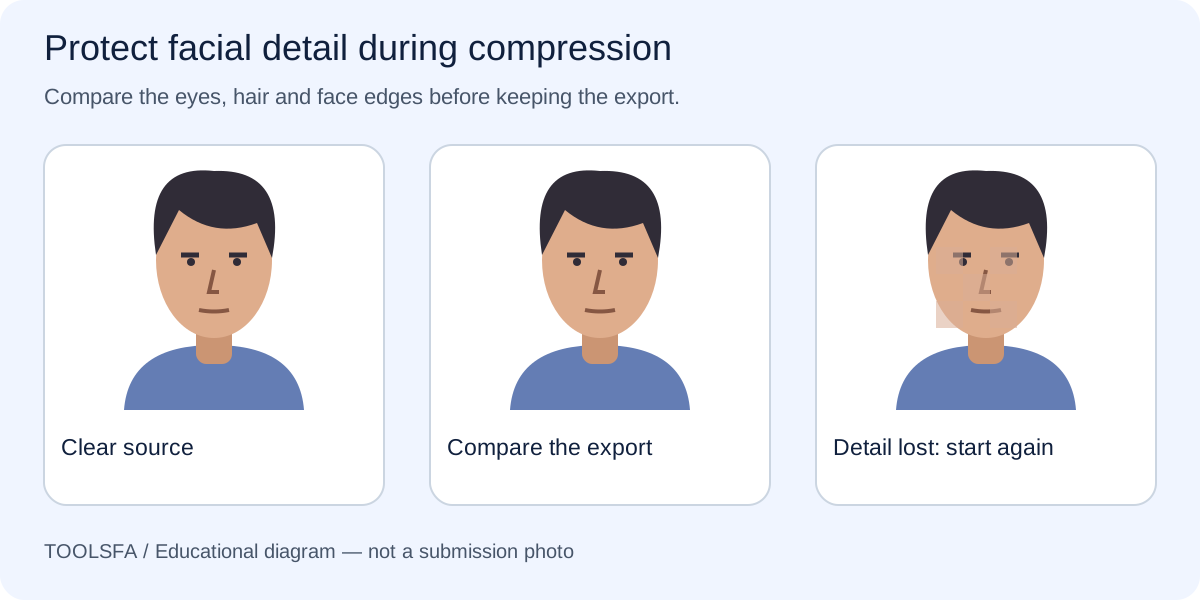
- Crop square before resizing to 600×600.
- Keep natural facial proportions.
- Recheck both measurements after every crop adjustment.
- Compare the final portrait with the official composition template and examples.
Worked example: convert the percentages to pixels
Assume the finished image is exactly 600 pixels high. A head-height range of 50%–69% means the distance from the bottom of the chin to the top of the head should be 300–414 pixels: 600 × 0.50 = 300 and 600 × 0.69 = 414.
The eye line is measured from the bottom edge. A 56%–69% range becomes 336–414 pixels above the bottom: 600 × 0.56 = 336 and 600 × 0.69 = 414. These calculations explain the overlay; they do not replace a visual check of pose, background and image quality.
Frequently asked questions
Is the eye line measured from the top or bottom?
Measure upward from the bottom edge of the finished square image to the level of the eyes. For a 600-pixel image, the official 56%–69% range equals 336–414 pixels from the bottom.
Can I resize the face to make the measurements pass?
Adjust the crop around the original portrait, but do not stretch or squash the face. If no natural square crop can satisfy both measurements while keeping the full head visible, retake the photograph with more space around the applicant.
Why can a centered face still fail composition?
Visual centering is not the same as meeting both vertical measurements. The head can be too small or too large, or the eyes can sit too high or low, even when the face appears centered.
Official sources
Always check the instructions for the program year in which you apply. ToolsFA is independent and is not affiliated with the U.S. government.