PDF editing guide
How to Edit a PDF Online Safely
PDF editing can mean adding a note, filling a blank, placing an image or covering visible content. The method matters because a visible cover is not the same as secure redaction.
Published September 13, 2026 · Practical guidance from ToolsFA
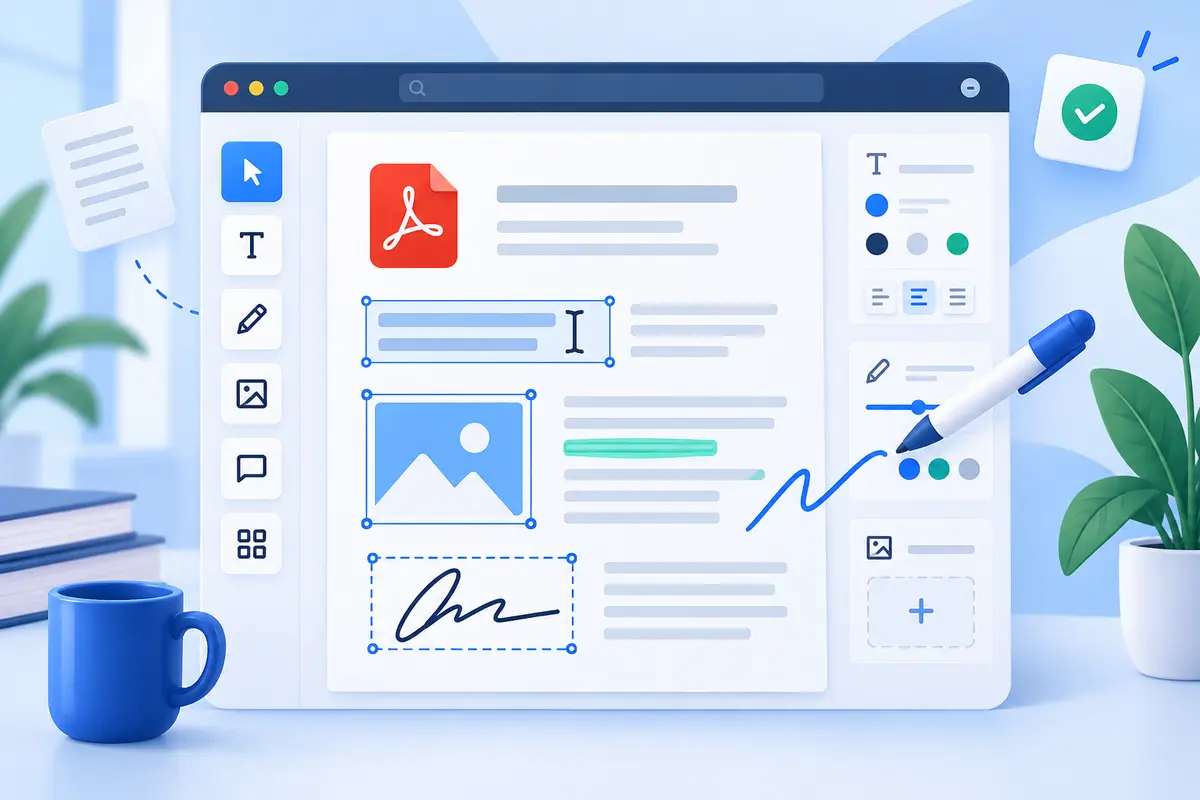
PDF editing actions and their limits
| Action | Useful for | Important limitation |
|---|---|---|
| Add text | Forms, labels and short corrections | May not change the original text layer |
| Whiteout | Covering visible non-sensitive content | Not secure redaction |
| Draw or add shapes | Review marks and simple diagrams | Can obstruct nearby content |
| Insert image | Logo, stamp or photo | Resolution and background may vary |
| Add signature | Visible electronic signing | Not a certificate-based digital signature |
On smaller screens, swipe horizontally to see every column.
Understand what is being edited
Some editors add new objects on top of a PDF page rather than rewriting the source content. This approach is dependable for notes, form entries, images, shapes and signatures because it leaves the original page intact beneath the new layer.
Replacing existing wording is harder. The original font may be embedded, letters may be stored separately, and nearby text may not reflow as it would in Word.
Whiteout is not secure redaction
A white rectangle can hide words visually, but the underlying text may still be searchable, selectable or recoverable. It can also reappear if another system removes annotations or changes layers.
Use a dedicated redaction workflow when removing personal, financial, medical or confidential information. After redaction, search for the removed phrase and inspect document properties and attachments.
Important: Never share a sensitive document based only on how it looks on screen.
Protect privacy while editing
For confidential files, understand whether the service uploads the document or processes it on the device. Browser-based processing can keep the selected file on the computer, although the browser still needs enough memory to handle large pages.
Avoid editing sensitive documents on shared computers. Close the file when finished and store the downloaded copy in an appropriate location.
- Keep an untouched original.
- Use descriptive filenames for revisions.
- Check every changed page after export.
- Confirm links, forms or signatures still behave as required.
Review before sending
Open the exported PDF in a different viewer, not only the editor. Zoom in on added text and images, check page boundaries, and confirm that nothing shifted or became clipped.
If the PDF is intended for printing, print or preview one representative page. Margins and thin marks can behave differently on paper.